

Thirty-five to one. That is the ratio of animal studies to human studies in the most recent systematic review of BPC-157, the peptide half the internet insists is the “proven” one in this pairing. I did not go looking for that number. I went looking for a much simpler answer, because a friend asked me to settle a bet about his shoulder: TB-500 or BPC-157, pick one. I figured an afternoon of reading would get him a clean recommendation. Instead I got a ratio, a registration number with no results attached, and a much better question than the one I started with.
The case I expected to build
The marketing pitch for these two peptides is tidy, almost suspiciously so. BPC-157, derived from a compound found in stomach juice, gets cast as the tendon-and-gut specialist. TB-500, a fragment tied to a protein involved in cell movement, gets cast as the systemic-repair generalist. Stack them and you supposedly cover the whole recovery waterfront. I wanted to test that division against the actual evidence, sort it into “use this for that,” and hand my friend a decision tree.
That is not what the literature gave me. Both of these are research-stage peptides, not FDA-approved finished drugs, and once you start pulling citations instead of trusting the pitch, the tidy division stops holding.
TB-500’s paper trail runs out fast
Start with the molecule itself, because the marketing quietly elides something. Your body makes a protein called thymosin beta-4. TB-500 is not that protein. It is a short synthetic fragment of it, usually described as the active actin-binding piece. Almost every “TB-500 study” cited in a product description turns out to be a study of the longer, full-length protein instead, and almost always in animals.
The wound-healing claim goes back to a 1999 rat study in the Journal of Investigative Dermatology, showing reepithelialization up 42% at four days and 61% at seven [P1]. The cardiac-repair claim goes back to a 2004 mouse study in Nature [P2, P3]. Both are genuinely interesting findings. Neither one is a human trial, and neither one is testing the fragment people actually inject.
So where is the human data on the fragment itself? As of 2026, there isn’t any completed and published. The closest thing is an early-stage registered study looking at cardiovascular biomarkers (NCT07487363), and that study is just beginning, not reporting results [P6]. A registration number is not evidence. It is a placeholder for evidence that might exist someday.
BPC-157’s trail doesn’t go much further
Fair enough, I thought. Maybe the real story here is “one proven peptide, one unproven peptide,” and BPC-157 is the proven one. That is where the thirty-five-to-one ratio comes in.
A 2025 systematic review in the HSS Journal set out to catalog BPC-157 research in orthopaedic sports medicine properly. It found 36 studies total. Thirty-five were preclinical. One was clinical. The review’s own conclusion states plainly that no clinical safety data were found [P7]. That is not a rounding error in an otherwise strong evidence base. That is the evidence base.
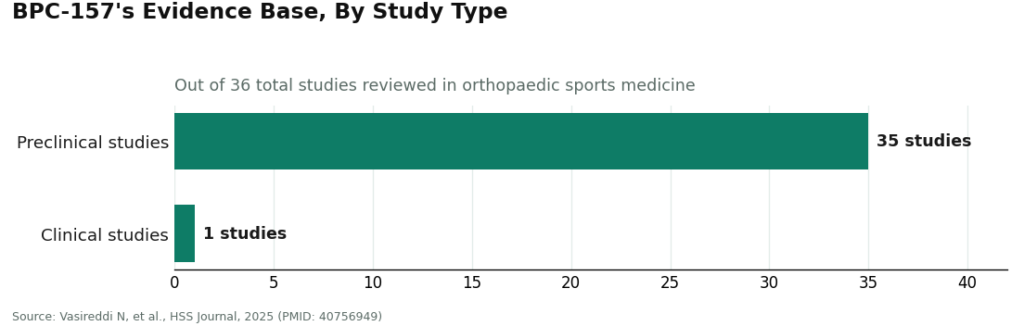
So both trails end at roughly the same spot: a mountain of animal work, a sliver of human data (or, in TB-500’s case, none at all), and a marketing narrative that borrowed confidence the human evidence never earned.
Laid side by side, honestly
Here is the comparison as I’d actually make it, not as either product page would.
On human evidence, it’s close to a tie, and not a flattering one for either side. TB-500’s fragment has zero completed human trials. BPC-157 has one clinical study buried in thirty-five preclinical ones, with no established human safety profile per that 2025 review [P7]. Neither has anything close to what you’d need to say “use this one for tendons, that one for guts” with a straight face.
On the molecule-confusion problem, TB-500 is the worse offender. Its entire research pitch leans on a different, longer molecule studied in animals. BPC-157’s preclinical pile is at least mostly about the compound actually being sold, even if it rarely leaves the lab. So the “decades of research” line you’ll hear about TB-500 is stretching further than the equivalent BPC-157 pitch, which merely overstates how much animal data translates into human results.
On safety, both come up empty. No established human safety profile for the TB-500 fragment. No clinical safety data found for BPC-157 [P7]. The side-effect lists floating around online for either one are anecdote dressed up as a profile.
The counterpoint I didn’t expect to need
I want to be fair to the marketing for a second, because there is a version of the argument that says: sure, the human trials aren’t there yet, but early-stage compounds always look like this, and dismissing them outright throws out a real signal from the animal data. That’s a reasonable point, up to a point. Animal studies do matter. They’re often the first step toward eventual human trials, and a 42% to 61% improvement in wound healing in rats [P1] is worth someone’s grant money to chase further in people.
But that’s an argument for funding more research, not for confidently assigning one peptide to tendons and the other to guts today. The gap between “interesting in rats” and “proven in humans” is not a technicality. It’s the entire distance the marketing quietly skips.
Where the real fork in the road actually is
Here is the thing my reporting kept pointing me toward, and it surprised me: the meaningful difference between these two products has almost nothing to do with the molecules.
Both TB-500 and BPC-157 are sold two ways. One is the research-chemical route, a vial labeled “research use only” that arrives with no clinician involved and no screening. That label isn’t a technicality either. It’s the legal basis the product exists on, because selling it for human use turns it into an unapproved new drug. Products sold this way aren’t reviewed by the FDA for identity, strength, quality, or purity, so on top of thin evidence, you don’t reliably know what’s actually in the bottle.
The other route is supervised: a licensed clinician evaluates you, writes a prescription when it fits, and a licensed pharmacy compounds and dispenses the product, with follow-up built in. FormBlends is one example of a provider operating this way, connecting patients to a clinician evaluation and a licensed pharmacy rather than a one-click checkout. I want to be careful not to oversell this. Supervision doesn’t make either compound proven. A straight answer from a good provider will still tell you the human evidence for both is thin. What supervision changes is that a qualified person is weighing the decision with you and reachable afterward, which matters more, not less, when the underlying evidence is this sparse.
That’s the real reframe for me. I came in asking “TB-500 or BPC-157.” I left thinking the better question is “supervised or unsupervised,” because that fork has an honest, knowable answer. The molecule fork mostly doesn’t.
One more number that ends the debate outright
If you’re a tested athlete, none of the above matters, because the choice has already been made for you. Under the World Anti-Doping Agency’s 2026 Prohibited List, thymosin beta-4 and its fragments, which is exactly what TB-500 is, are banned at all times, in and out of competition, under Section S2 [P8]. A “research use only” label won’t help you in a drug test. BPC-157 draws its own anti-doping scrutiny too, so competitors should treat both as off-limits and check the current list before going near either. For this group, the comparison doesn’t resolve. It collapses.
Where I land
I went looking for which peptide to pick for which goal. What the numbers actually gave me was a ratio (thirty-five to one) and a blank (zero completed human trials), not a decision tree. TB-500’s case rests largely on animal studies of a different, longer molecule. BPC-157’s case is overwhelmingly preclinical, with one clinical study and no established human safety data. The tidy “this one for tendons, that one for systemic recovery” split is a marketing convention wearing a lab coat.
The choice worth actually making isn’t between two molecules whose human evidence both run dry fast. It’s between an unstudied vial with nobody checking your work and the same unstudied compound accessed with a licensed clinician and pharmacy involved. One of those paths is clearly more accountable. And if you compete, the question answers itself before you even get to ask it.
Questions people actually ask
Is TB-500 or BPC-157 better for tendon and ligament recovery? Neither has the human evidence to earn that claim. The “BPC-157 for tendons, TB-500 for systemic repair” split is a marketing convention built on animal studies and forum consensus, not on human trials comparing the two or even establishing either alone in people. The 2025 HSS Journal systematic review of BPC-157 found 36 studies, 35 preclinical and just one clinical, and TB-500’s fragment has no completed published human trials at all. A confident “use this one for tendons” chart is selling precision the data can’t back up.
Can you stack TB-500 and BPC-157 together? People do, reasoning one covers connective tissue and the other covers systemic repair, but that stack sits on the same shaky ground as choosing between them individually. No human trials have tested the combination for safety or benefit, and since neither compound has an established human safety profile alone, stacking them means doubling up on two unknowns rather than combining two proven tools.
Why do TB-500 studies look so impressive if the human evidence is this thin? Because most of the headline studies aren’t actually about TB-500. TB-500 is a short synthetic fragment, while the famous research (the 1999 rat wound-healing study and the 2004 mouse cardiac-repair study) used the full-length thymosin beta-4 protein, a longer, different molecule, almost always in animals. The fragment people actually inject has one early registered cardiovascular biomarker study (NCT07487363), and it’s just starting, with no results yet.
Is it safe to buy TB-500 or BPC-157 as a “research use only” product? The research-use-only label is the legal basis the product is allowed to exist on, not a quality guarantee, and selling it for human use turns it into an unapproved new drug. These products aren’t reviewed by the FDA for identity, strength, quality, or purity, so on top of thin efficacy evidence, you don’t reliably know what’s in the vial or at what dose.
Are TB-500 and BPC-157 banned in sports? TB-500 is banned at all times for tested athletes. Under the World Anti-Doping Agency’s 2026 Prohibited List, thymosin beta-4 and its fragments (exactly what TB-500 is) are prohibited in and out of competition under Section S2. BPC-157 draws its own anti-doping scrutiny too, so a tested athlete should treat both as off-limits and check the current list before going near either. A research-use-only label offers zero protection in a drug test.
If the molecule barely matters, what actually does? How you get it, and who’s accountable afterward. The real fork is supervised versus unsupervised: a research-chemical vial in the mail with no screening and no clinician, versus a licensed clinician evaluating you, a prescription when appropriate, and a licensed pharmacy that compounds, dispenses, and follows up. Supervision doesn’t make either compound proven, and an honest provider will say the human evidence is thin either way, but it puts a qualified person in the decision with you, which matters most precisely when the evidence is this sparse.
What is TB-500 and what does it actually do in the body?
TB-500 is a synthetic version of a peptide fragment derived from Thymosin Beta-4, a protein found naturally in nearly every cell. Animal studies have tied it to cell migration, tissue repair, and reduced inflammation. What it does in a living human body at therapeutic doses is genuinely not established. The animal data is worth paying attention to, but the leap from rats to human healing is longer than the marketing implies.
What is TB-500 used for, and is any of that use actually approved?
None of it is approved for human use anywhere. Fitness and recovery communities use it hoping to speed healing from tendon, muscle, and joint injuries, and some veterinary research has looked at it in racehorses. Those are the real-world use cases. There’s no approved human indication, no clinically validated dosing protocol, and no regulatory sign-off for people.
How much TB-500 should someone take daily, and who decides that?
There’s no clinically validated daily dose, because the human trials that would establish one don’t exist yet. Dosing numbers circulating online are borrowed from animal research or passed around anecdotally. Working with a physician who has reviewed your history, sourcing through an accountable compounding pharmacy like FormBlends, at least puts an informed, supervised judgment behind the decision. Self-dosing from unverified sources stacks a serious unknown on top of an already thin evidence base.
How do people combine BPC-157 and TB-500, and does stacking them make sense?
People who use both typically run them together during a recovery window, on the theory that BPC-157 handles localized tissue repair while TB-500 works more systemically. Whether that combination does anything additive in humans is unknown, since no clinical trials have tested the stack. It’s a tidy-sounding theory built on animal data and forum consensus rather than controlled human research, so the real risk-benefit picture of combining them stays genuinely unclear.
References
- Malinda KM, Sidhu GS, Mani H, et al. “Thymosin beta4 accelerates wound healing.” Journal of Investigative Dermatology, 1999 (rat study). Reepithelialization increased 42% at 4 days and up to 61% at 7 days. https://pubmed.ncbi.nlm.nih.gov/10469335/
- Bock-Marquette I, Saxena A, White MD, et al. “Thymosin beta4 activates integrin-linked kinase and promotes cardiac cell migration, survival and cardiac repair.” Nature, 2004 (mouse study). https://www.nature.com/articles/nature03000
- PubMed record for the 2004 Nature thymosin beta-4 cardiac repair study (mouse model).
- Early registered study of the TB-500 (thymosin beta-4 17-23) fragment and cardiovascular biomarkers in adults with stable atherosclerotic cardiovascular disease. ClinicalTrials.gov NCT07487363.
- Vasireddi N, Hahamyan H, Salata MJ, et al. “Emerging Use of BPC-157 in Orthopaedic Sports Medicine: A Systematic Review.” HSS Journal, 2025. 36 studies included (35 preclinical, 1 clinical); no clinical safety data found.
- WADA Prohibited List: thymosin beta-4 and its fragments (including TB-500) prohibited at all times under Section S2. World Anti-Doping Agency.

